
Brand pillars are the three or four themes a brand commits to showing up with everywhere: in its ads, its product decisions, its support emails, its social posts. Pick any message a brand puts out and you should be able to trace it back to one pillar. If you can't, either the message is off-brand or the pillars don't exist outside the strategy deck they were written in.
Most brands don't fail because their work looks bad. They fail because it all looks like it came from different companies. Pillars are the fix: a small, memorable set of themes that keep a growing team pointing the same direction without a strategist in every meeting.
This guide covers what brand pillars are, how they differ from values and messaging pillars, how to define yours, and where the definition should live so it actually gets used (spoiler: not in a PDF).
What Are Brand Pillars?
Brand pillars are the core themes a brand builds its identity and communication around, chosen deliberately in the brand strategy and then reinforced in every piece of content the brand produces. They sit between the strategy and the day-to-day work: the strategy says who the brand is for and why, and the pillars translate that into themes a designer, writer, or account manager can apply without re-reading the strategy document.
A useful way to think about them is structural. A building has a small number of pillars holding up everything else. A brand works the same way: every campaign, product decision, and customer interaction should rest on the pillars, and anything that doesn't sit on them is decoration at best, off-brand noise at worst.
Where teams get tangled is the vocabulary, because three different things get called "brand pillars" depending on who you ask:
- Brand pillars in the strategy sense: the 3-4 themes the brand is built around, like "sustainability", "craftsmanship", and "accessibility" for an outdoor clothing company.
- Brand messaging pillars: the 2-3 key messages every piece of communication should reinforce, often used as a synonym but really the messaging layer built on top.
- Brand values: how the team behaves internally, which should be consistent with the pillars but is not the same document.
This guide uses the strategy sense, and treats messaging as what you build after the pillars exist. If you're also working on the layer above this one, the brand strategy template covers the full strategy document the pillars sit inside.
Which Pillars Should a Brand Have?
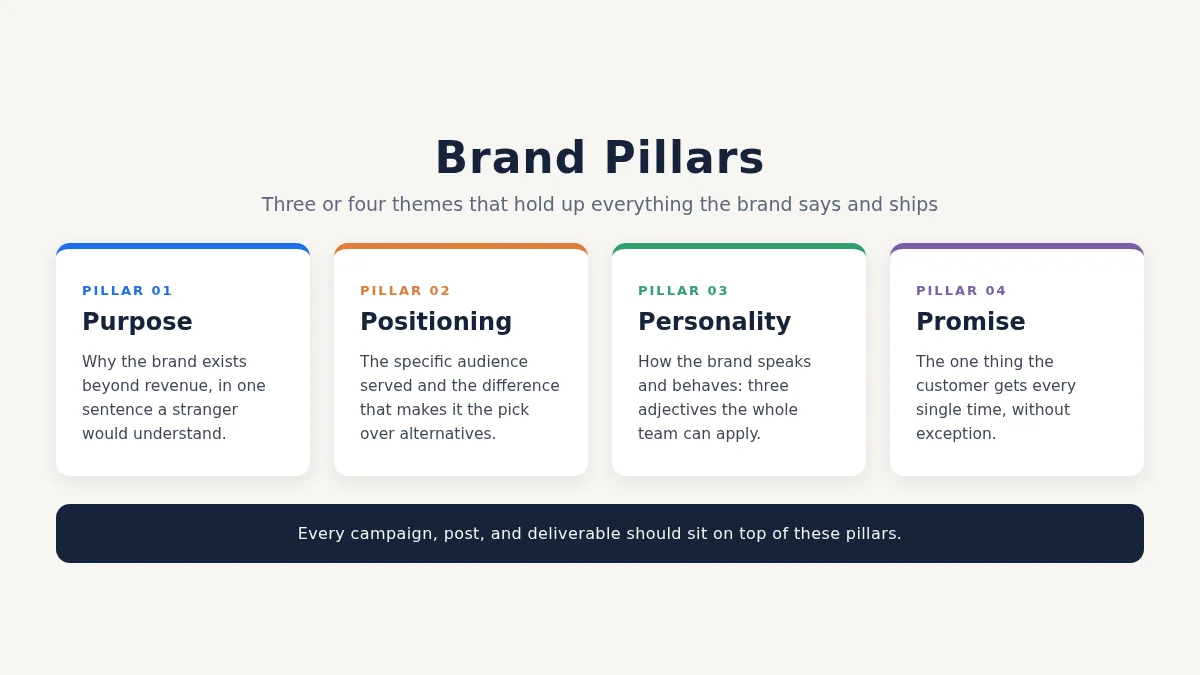
There's no universal list, and the articles that claim there is are usually selling a workshop. You'll meet five-pillar frameworks in the wild (purpose, positioning, personality, perception, promotion is the common one, and our own earlier branding fundamentals post uses it), and they're a fine starting point too. What matters is that you end up with three or four themes that are specific to your brand and useful to the people creating for it. A common and durable starting structure covers four areas:
Purpose
Why the brand exists beyond making money, in one sentence a stranger would understand. Not a poster slogan, a reason someone would miss you if you closed.
Positioning
Who the brand is specifically for and what makes it the better pick against the realistic alternatives. If your positioning statement could describe your competitors as easily as you, it isn't a position.
Personality
How the brand speaks and behaves: usually three adjectives, plus one thing to avoid. This is what keeps a hundred different writers sounding like one company.
Promise
The one thing the customer gets every single time, no exceptions. The thing you'd refund over.
Fill those four and you'll usually notice one of them matters less to your audience and can drop, leaving a tighter set of three. What you should not do is pick eight because they all sounded good in the workshop. A list that long is not pillars, it's brainstorm residue: nobody can hold eight themes in their head while writing a caption, so they'll fall back on habit and the list stops doing anything.
Brand Pillar Examples
Concrete examples help, so here are well-documented ones from brands most people know. These are read from public positioning, not insider knowledge, which is exactly the point: if a brand's pillars are working, you can infer them from what it consistently does.
Patagonia. Purpose-led environmentalism as a defining theme: repair over replacement, activism as marketing, and product decisions that follow the environmental stance even when they cost sales. Whatever you think of the brand, its themes are unmistakable across everything it publishes.
Volvo. Safety as the pillar every message sits on, for decades. It shapes ads, product priorities, and even how competitors describe themselves. The positioning is public: read their product pages and the theme repeats on every one.
Mailchimp. Personality as a pillar in itself: plain-spoken, a bit weird, never corporate. That tone carried across thousands of help articles is why the brand reads like one voice rather than a support department. Browse their guides and count how many sentences could plausibly have come from a bank.
Dove. "Real beauty" as a promise pillar since 2004: ordinary customers in the advertising, product lines built on the same stance, and a willingness to be mocked by ad critics in defense of it. The campaign's own site is the primary source.
Notice what the examples have in common: each brand's themes are legible in the output, not just the strategy deck. That's the test of real pillars. If yours only exist in the document where they were defined, the exercise so far has been creative writing.
How to Define Your Brand Pillars
Run this as a single working session with the people who make decisions about what the brand says and ships. For agencies, that means the client in the room, not just your strategists. A workshop that produces pillars the client never agreed to has produced a document nobody will defend.
- Write down what the brand refuses to be. Ten minutes on the negatives first. A brand defined only by what it wants to be is a brand defined by nothing, because "innovative and customer-focused" rules out nothing. The refusals are what make the eventual choices mean something.
- Steal from the strategy, don't invent fresh. If a brand strategy exists, the pillars should fall out of its positioning and promise sections. If it doesn't, write the one-line purpose and positioning statements first, then derive themes from them. Pillars invented before the strategy exists usually turn out to be generic because there was nothing specific to derive them from.
- Draft themes, then stress-test each one. For every candidate theme ask: would a competitor be embarrassed to claim this? Could a designer act on it tomorrow without asking a follow-up question? A theme that fails either test is a value, not a pillar.
- Cut to three or four. Force the ranking. The theme that hurts most to cut is usually a real pillar, and the ones that go quietly were padding.
- Write the proof for each pillar. One or two lines per pillar on what evidence backs it: products, decisions, content, history. A pillar with no proof behind it is a wish.
- Name an owner and a review date. Same rule as any other deliverable. A pillar set with no owner decays into trivia inside a year.
The whole session should fit in two to three hours. If it needs two full days of offsite, you're doing the strategy work too, and that's a different (also worthwhile) session.
Where Brand Pillars Live (and How They Get Used)
A pillar set that lives in a slide deck is already dead. The deck gets opened once, exported as a PDF, attached to an onboarding email, and never searched again. The people who need it most, the ones creating brand material a month later, can't find it and quietly fall back on their own taste.
The pillars need to live where the work happens:
- In the brand guidelines, as a written section near the top, so the "how we look and sound" rules trace back to the "why". If your guidelines are a PDF, this is the moment to reconsider, because brand guidelines go stale the day they're published unless they pull from something that updates.
- In the creative brief, as a required field. Every creative brief should name which pillars the project leans on, which forces a real decision instead of "on-brand" as a vibe.
- In the review checklist. Whoever approves brand material needs a one-line question: which pillar is this on? If the answer is a shrug, it goes back.
For teams running multiple brands, like agencies, there's an additional rule: pillars are per-brand and belong with that brand's assets, not in the agency's own internal template. That's the setup that keeps 15 client brands from drifting into one shared house style, and it's exactly the problem multi-client brand asset management exists to solve: each client's library, guidelines, and pillars stay isolated while one team serves all of them.
Frequently Asked Questions
What are brand pillars?
Brand pillars are the three or four core themes a brand builds its identity and communication around, chosen in the brand strategy and reinforced across every campaign, product decision, and piece of content. They translate the strategy into themes any creator can apply without re-reading the whole strategy document.
How many brand pillars should a brand have?
Three or four. Fewer than three tends to be too narrow to cover how a real brand behaves, and more than four stops being memorable, so the team ignores the list and falls back on habit. If a workshop produces eight strong candidates, the ranking exercise matters more than the list itself.
What's the difference between brand pillars and brand values?
Brand pillars are outward-facing themes the brand communicates through its work. Brand values are inward-facing rules for how the team behaves. They should be consistent with each other, but a value like "move fast" doesn't need to be a public pillar, and a pillar like "safety" says nothing about internal workflow.
What's the difference between brand pillars and messaging pillars?
Brand pillars are the strategic themes the brand is built around. Messaging pillars are the 2-3 key points every piece of communication should reinforce, derived from the pillars. In practice the terms get used interchangeably, which is fine until two departments produce conflicting documents, at which point the strategy sense wins.
Do brand pillars belong in a brand book?
Yes, as an early section, but the pillars shouldn't only live there. A brand book or brand kit covers how the brand looks and sounds, and the pillar section gives those rules their reasoning. The pillars also need to reach the creative brief and the review checklist, or they stay decorative.
How often should brand pillars be revisited?
Seriously revisited every 12 to 18 months, or when the market, audience, or product changes materially. Light review quarterly against whatever measurement the strategy defines. A pillar set that survives three years untouched is usually just unowned rather than durable.
Get Started
If you already have pillars written down, the fastest win is moving them out of the deck and into something your team opens weekly. Baseline stores each brand's guidelines and assets as a live, shared page your clients and team can reference, so a guideline update reaches everyone without shipping a new PDF. Try Baseline free and put this week's pillar review somewhere it will actually get read.
Related reading: the brand strategy template for the document your pillars sit inside, what a brand book is for how the visual rules get captured, and the creative brief template for the project-level brief that should name its pillars.