
A brand strategy that lives in someone's head is not a strategy, it's an opinion that has to be re-explained in every kickoff call. Most agencies don't lose clients because the branding was wrong. They lose them because the strategy was never written down in a form the client actually agreed to, so every deliverable gets measured against a goal nobody can quote.
A brand strategy document fixes this: one page, filled out before the design work starts, that says who the brand is for, what it promises, and how it will be recognized. This guide gives you a template you can copy as-is, a filled-out example, the mistakes that make strategy documents useless, and how Baseline's brand guide creator turns the finished strategy into a live page your client's whole team can reference.
What Is a Brand Strategy?
A brand strategy is the deliberate plan behind how a brand competes: the audience it chooses, the position it takes against alternatives, the promise it makes, and the personality and voice it uses to deliver that promise consistently. It's the layer above tactics. Where a creative brief defines one project, the brand strategy defines the rules every project inherits.
It is not the same thing as brand identity. Identity is the visible output: the logo, colors, typography, and imagery, usually collected in a brand book or brand kit. Strategy answers why those choices were made and who they're for. Identity without strategy is decoration; strategy without identity is a memo nobody can apply. A good strategy document connects the two: every identity decision in it traces back to a stated audience and position.
Brand Strategy Template
Copy this. Every section has a one-line prompt so you know what actually goes in it, not just a vague header.
Brand name and one-line description: [the brand in one sentence a stranger would understand]
Purpose: Why does this brand exist beyond making money? One sentence, not a poster slogan.
Vision: Where is this brand in five years? Concrete enough that someone could check whether it happened.
Target audience: Who is this for, specifically? The person, their situation, what they currently use or believe. Not "everyone" and not "women 25-45".
Market and competitors: 2-3 alternatives this audience would realistically compare us to, and what they each claim. If you can't name them, you can't position against them.
Positioning statement: For [audience], [brand] is the [category] that [key difference], because [reason to believe]. One sentence, fill-in-the-blanks, no cheating on the blanks.
Brand promise: What does the customer get every single time, no exceptions? The thing you'd refund over.
Brand personality and voice: Three adjectives, plus one thing to avoid (e.g., "confident, plain-spoken, generous; never smug or corporate").
Key messages: The 2-3 points every piece of communication should reinforce. If a message doesn't ladder up to the positioning, it doesn't belong here.
Proof points: What evidence backs the promise? Numbers, certifications, named results. A promise with no proof is copy, not strategy.
Visual and verbal identity direction: The logo system, color, typography, and photography direction, with one line each saying why it serves the strategy. Link the actual asset files here, not a Dropbox folder of final_v7s.
Brand pillars: The 3-4 themes the brand talks about repeatedly, the ones every campaign and post should sit under.
Measurement: How will you know the strategy is working in 6-12 months? Awareness, perception, retention, or revenue metrics, with a baseline number for each.
Owners and review cadence: Who maintains this document, and when does it get revisited? A strategy nobody owns decays into a PDF nobody opens.
Brand Strategy Example (Filled In)
Here's the template filled out for a fictional mid-sized B2B software brand, so you can see what "done" looks like. It's deliberately short. If your version needs ten pages, you're writing a manual, not a strategy.
Brand name and one-line description: Northlane. Onboarding software for compliance-heavy financial firms.
Purpose: Compliance work is the most hated part of onboarding new financial clients. Northlane exists to make it take minutes instead of weeks.
Vision: In five years, the default onboarding stack at every regional bank and fund administrator in the Nordics.
Target audience: Operations leads at 50-500 person financial firms who currently manage client onboarding through a shared inbox, spreadsheets, and a compliance officer who says no a lot.
Market and competitors: Legacy workflow suites (powerful, six-month implementations), and generic form tools (fast to start, fail audits). Nobody sells specifically to compliance-heavy onboarding at mid-market size.
Positioning statement: For ops teams at mid-sized financial firms, Northlane is the onboarding platform that satisfies your compliance officer and still launches in a week, because every workflow ships with audit trails built in.
Brand promise: Onboarding that passes audit the first time.
Brand personality and voice: Precise, calm, and quietly confident. Never dramatic, never hype, never "revolutionary".
Key messages: Audit-ready by default. Live in a week. Built for the mid-market, not the enterprise.
Proof points: 40+ firms onboarded, average go-live of 9 days, zero failed client audits in 2026.
Visual and verbal identity direction: Deep navy and off-white, one sharp accent, serif headings for gravitas. Photography of real workspaces, not stock handshakes. Every page passes a contrast check because our audience includes compliance reviewers who read everything twice.
Brand pillars: Audit readiness, mid-market fit, speed without shortcuts.
Measurement: Double branded search volume and free trial signups from financial firms within 12 months. Baseline both in the document.
Owners and review cadence: Founder owns the document, reviewed quarterly against the measurement numbers.
Notice what the example does: every identity choice ties back to the audience. Serif headings aren't a taste decision, they're a signal to an audience that distrusts flashy. That traceability is the whole difference between a strategy document and a mood board with headers.
Brand Strategy Mistakes That Make the Document Useless
Writing values instead of choices. "Innovative, passionate, customer-focused" is in every strategy document ever written and rules out nothing. A strategy is defined by what it says no to. If your positioning statement could describe your competitors equally well, it isn't a position.
Describing the audience as a demographic. "Women 25-45" doesn't tell a designer anything. The person, their situation, and what they currently believe is what makes creative decisions possible.
No proof points. A promise without evidence is marketing copy. List the numbers, names, or certifications that make the promise credible, or mark the promise as a goal so nobody quotes it as fact.
Never deciding who owns it. The strategy gets written in a workshop, exported to PDF, and never opened again. Name the owner and a review date, same as you would for any other deliverable.
Confusing the strategy with the guidelines. The strategy says who and why. The brand guidelines say how: logo rules, color values, spacing, tone examples. Clients need both, but they are different documents with different jobs. The strategy is the input; the brand guide is the reference everyone uses daily.
From Template to Live Brand Guide
The template above gets the strategy out of your head. The next problem is that a strategy document is still a file, and files rot. The client's team goes looking for the logo the week after launch, finds last year's export in an email, and the strategy's careful identity direction is quietly abandoned.
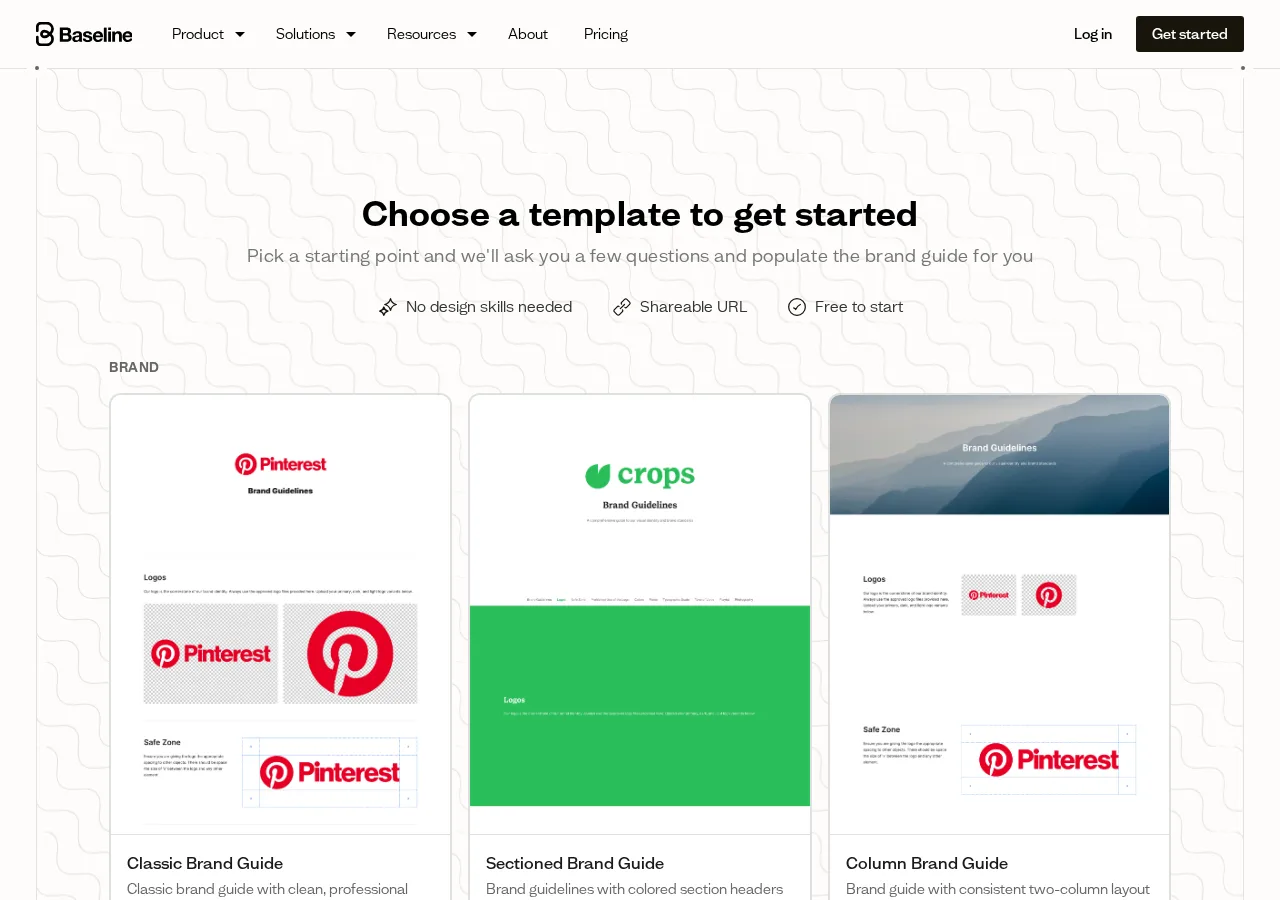
That's why the last section of the template says link the actual assets, and why the handoff shouldn't stop at a PDF. With Baseline's brand guide creator you publish the strategy and the assets it references as a live, branded page: the positioning and pillars as written sections, the logos, colors, and fonts pulled straight from the asset library, so updating a color in the DAM refreshes the published guide automatically. Agencies running this as a client deliverable report exactly this outcome, clients stop asking "where's the logo file" and start sending the guide link around themselves, the way WSI Peak Digital Strategy describes it: "they really appreciate having a link to their brand guideline".
The workflow ends up looking like this:
- Fill out the strategy template with the client in one working session, not a five-week discovery phase.
- Collect the actual assets: logos, fonts, colors, photography, through an intake form rather than an email chain.
- Publish the strategy and the assets as a live brand guide.
- Review the measurement section quarterly, and update the guide in place instead of shipping v2 PDFs.
If your strategy document also feeds project-level work, pair it with a creative brief template for campaign and project specifics, and a design brief template when the deliverable is visual design work.
FAQ
What is a brand strategy template?
A brand strategy template is a pre-structured document with sections for the core strategic choices: audience, positioning, promise, personality, messages, proof, and measurement. Each section prompts you to make one specific decision, so a workshop ends with a filled-out strategy instead of a pile of sticky notes.
How long should a brand strategy document be?
One to three pages. Long enough to cover every section of the template with a real decision, short enough that the client's team will actually read it. If it needs a table of contents, it's a brand manual, not a strategy.
What's the difference between a brand strategy and brand guidelines?
Brand strategy defines who the brand is for, what it promises, and how it's positioned. Brand guidelines define how the brand looks and sounds in practice: logo usage, colors, typography, tone examples. Strategy is decided once per positioning effort; guidelines are referenced daily.
Can I use this brand strategy template for a client?
Yes, that's what it's for. Run it as a single working session with the client, fill every section with decisions they agree to in writing, and deliver the result as a live brand guide so their team can actually use it.
How often should a brand strategy be reviewed?
Quarterly against the measurement section, and seriously revisited every 12-18 months or when the market, the audience, or the product materially changes. A positioning that survives three years unexamined is usually just unowned.