
Brand governance is the decision structure a company wraps around its brand: which rules exist, who has the authority to make, change, and approve brand decisions, and how the rules get enforced when nobody is watching. Most brands have guidelines. Far fewer have governance, because governance is the part that answers "who decides?", and that question is uncomfortable enough that teams skip it.
The distinction matters because guidelines fail quietly. A 60-page brand book that nobody enforces, an outdated logo still circulating in a sales deck, a regional team launching a campaign with off-brand colors: none of those are documentation problems. They're governance problems, and adding pages to the brand book doesn't fix them.
This guide covers what brand governance is, how it differs from brand guidelines and brand compliance, the four parts of a working governance framework, and how to build one without turning every project into a committee meeting.
What Is Brand Governance?
Brand governance is the framework of policies, ownership, and decision-making rights that keeps a brand consistent as more people touch it. It covers who can create brand assets, who reviews and approves them, what the standards are, and what happens when something is off-brand.
A useful way to hold the idea: governance sets the rules, compliance enforces the rules, and consistency is the outcome when both work. A brand with real governance isn't policing every pixel. It has made a small number of decisions up front, so the everyday decisions get easier.
Three signs a brand has governance rather than just documents:
- There's a named person or role who can say "no" to off-brand work and that answer sticks.
- Anyone in the company can find the current, approved version of a logo, color, or template in under a minute.
- When the brand changes, the change reaches the places the brand lives without a scavenger hunt.
If those three are true, the underlying framework may be informal, but it exists. If they're not true, no amount of documentation substitutes for it.
Brand Governance vs Brand Guidelines vs Brand Compliance
These terms get used interchangeably, which causes real confusion about what a team actually needs to build.
Brand guidelines are the artifact: the document, site, or portal that records how the brand looks and sounds. Brand compliance is the process: the workflows and checks that keep everyday work inside those guidelines. Brand governance is the structure above both: the ownership and decision rights that decide what the guidelines say, who can change them, and how compliance gets enforced. We break down the compliance side separately in what brand compliance means, because the enforcement layer has its own challenges around version control, scattered assets, and training.
The relationship runs downward. Governance produces the guidelines. The guidelines feed the compliance checks. When the brand drifts anyway, the fix usually sits at the top of that chain: the governance layer never specified who owns the decision that went wrong.
The Four Parts of a Brand Governance Framework
Every workable brand governance framework, from a two-person studio to an enterprise brand council, has four parts. The scale changes; the parts don't.
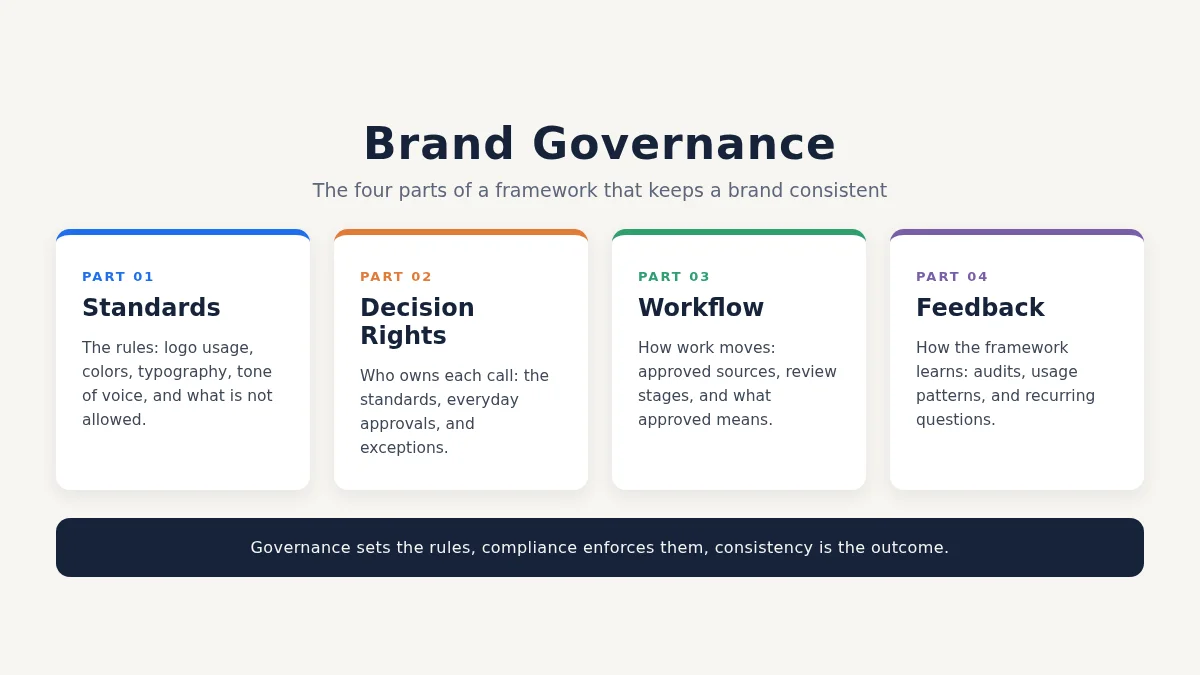
Standards are the rules themselves: logo usage, the color palette, typography, tone of voice, photography style, and what's explicitly not allowed. They only work if they're specific enough to settle an argument, which is why they should trace back to a written brand strategy: standards without strategic reasoning behind them turn into arbitrary preferences.
Decision rights answer who owns which call. Who approves a new campaign visual? Who can approve a vendor's use of the logo? Who decides when a partner's request gets an exception? Naming these owners is the single highest-leverage governance act, because most brand chaos is really decision chaos: an approval nobody was empowered to give, an exception nobody was authorized to grant.
Workflow is how work moves through the rules: where a designer gets the current assets, which review stage a piece passes through before it ships, and what "approved" physically means in your tooling. A governance framework without workflow is a policy document people nod at and ignore.
Feedback is how the framework learns. Audits of published materials, download and usage patterns, and questions that keep coming back all signal where the standards are unclear or the workflow is failing. Brands that never look at this loop repeat the same governance failures every quarter.
Who Owns What: Decision Rights That Work
Most governance breakdowns trace back to a decision that had no owner. The fix is usually a short, explicit list:
- A single brand owner holds the final call on the standards themselves. In a small company that's the founder or marketing lead; in a larger one it's a brand or creative director. One person, not a committee, because standards-by-committee drift into mush.
- Named reviewers hold approval authority for everyday work, typically one for visual identity and one for copy. Reviewers apply the standards; they don't rewrite them.
- Every creator owns the responsibility to use approved sources and flag gaps. If a designer can't find the current logo, that's a governance failure to report, not a reason to rebuild the logo.
- Leadership owns backing the whole structure when a fast, off-brand shortcut is tempting. Governance that leadership quietly routes around doesn't exist.
For agencies, decision rights need one more layer: they're per client, not per agency. Each client brand needs its own owner, its own standards, and its own approval chain, which is exactly the isolation that brand asset management exists to support: one team serving many brands without the brands leaking into each other.
How to Build a Brand Governance Framework in 5 Steps
You can build a working framework in a week or two of focused work. The order matters more than the polish.
- Write down the rules that already exist. Before inventing policy, capture what your team actually does: which logo is the real one, which colors are allowed, who people email when they're unsure. Most of your framework is already practiced, just not recorded.
- Name an owner for every recurring decision. Go through the list from the previous section and put a name against each call. Ambiguity here is the root cause you're fixing, so this step is the framework.
- Make the approved source findable. Governance assumes people can reach the current standards and assets, which is why a single source of truth beats a folder structure nobody maintains. If your guidelines are a PDF, this is the moment to switch: brand guidelines go stale the moment they're published unless they pull from something that updates.
- Move the checks into the workflow. Set up review stages with clear statuses so approval is a state work passes through, not a meeting. A Kanban-style board grouped by approval status gives everyone a live view of what's draft, in review, approved, or rejected, without status meetings.
- Schedule the feedback loop. Pick a recurring moment, monthly or quarterly, to review what shipped, which rules got questioned, and which assets people couldn't find. The framework that never gets revisited calcifies into bureaucracy or gets ignored, usually both.
Brand Governance for Agencies and Multi-Brand Teams
Agencies face the same governance problems as in-house teams, multiplied by every client on the roster. A brand governance framework that assumes one brand breaks the second a second client signs.
The working pattern is isolation with shared standards:
- Each client gets their own library, their own guidelines, and their own approval chain, with permissions scoped so nobody sees a client they don't work on.
- Client-facing access runs through a branded client portal rather than raw file links, so clients see approved assets only, and the agency controls the presentation.
- New client onboarding includes the governance setup, not just the asset handover: who approves on the client side, what the review stages are, and where their assets live. A structured client onboarding process is the natural place to record it.
- Guest and freelancer access is scoped to the specific project board, so external collaborators can work inside the rules without seeing other clients' materials.
Done this way, governance scales with the roster instead of degrading. The agency keeps one way of working, and every brand stays itself.
Where Governance Fails: Honest Tradeoffs
A framework can fail in two directions, and both are worth naming.
Over-governance turns every asset into a three-week approval carousel. The symptoms: work queues behind reviews nobody prioritizes, teams start routing around the process, and the framework's real function becomes saying no. The cure is fewer, better-defined decisions with real owners, not more checkpoints.
Under-governance is the default state: pleasant velocity, consistent brand erosion. Sales uses the old logo, a partner stretches it, a new hire guesses the colors. The cure is the minimum viable structure from the five steps above.
The honest tradeoff is that governance trades a little speed for a lot of consistency, and the exchange rate depends on how well the rules are written and how easy the approved path is. The teams that complain governance is slow are usually describing governance with a bad workflow: the framework can't be faster than people's ability to find the current asset and get a decision from the named owner. That's why the source of truth and the decision rights come before the checkpoints in the build order.
How Baseline Supports Brand Governance
Baseline is a digital asset management platform that combines the storage layer and the publishing layer, which lines up with the two parts of governance teams struggle with most: findability and enforcement.
- A centralized library gives governance its single source of truth: logos, fonts, complete color palettes, and photography in one place, with version control so outdated assets stop circulating as current ones.
- Live brand guidelines pull directly from that library, so the standards document updates when the assets do, instead of drifting.
- Approval workflows run on custom fields and Kanban views, so review is a visible state in the workflow rather than an email thread.
- Branded portals and scoped guest access let clients and freelancers work inside the rules without exposing everything else.
- Granular permissions support the multi-brand pattern agencies need: per-client libraries with access controls that keep each brand's governance separate.
You can start on the free plan and build the framework as you go, with no trial countdown and no credit card.
Frequently Asked Questions
What is brand governance in simple terms?
Brand governance is the answer to three questions about your brand: what are the rules, who makes and enforces them, and how do they reach everyday work. If nobody can answer those questions, the brand has guidelines but no governance.
What's the difference between brand governance and brand management?
Brand management is the ongoing work of building the brand: campaigns, positioning, market feedback. Brand governance is the structure that decides how that work happens: the decision rights, standards, and enforcement that keep the management work consistent as the team grows.
Who should own brand governance?
One named brand owner holds final authority over the standards, with named reviewers holding everyday approval authority. The exact titles matter less than the clarity: every recurring brand decision needs a person who owns it.
What does a brand governance framework include?
Four parts: standards (the rules), decision rights (who decides), workflow (how work passes through the rules), and feedback (how the framework learns from what ships). The formality scales with the team, but all four parts need to exist.
How do you measure brand governance?
Watch the failure signals: how often off-brand material ships, how long people spend finding current assets, how many approvals get routed around, and which rules keep generating questions. A working framework shows up as fewer of all four.
Get Started
Pick one thing from this guide and do it this week: write down your recurring brand decisions and put a name next to each one. That list is the seed of your framework, and every other part, the standards document, the workflow, the feedback loop, builds on it.
If you want the tooling to match, start free on Baseline and set up your first library: your logo, colors, and fonts in one place, with approval states ready when you are.
Related reading: what brand compliance means for the enforcement layer, living brand guidelines for standards that update themselves, and brand asset management for the multi-client setup agencies run on.