
Bynder and Brandfolder are the two names that come up in almost every enterprise DAM shortlist, and most "Bynder vs Brandfolder" pages are written by one of the two vendors or by a comparison site that has never seen a contract. This page is neither. It compares the two platforms on what actually differs, gives you the pricing numbers neither vendor publishes, and names the situations where you should not buy either one.
The short version: Bynder is the deeper, more modular enterprise platform with a serious AI layer and a three-month onboarding process. Brandfolder is the more usable one, owned by Smartsheet, with asset analytics as its standout feature and unlimited guest users as its sleeper benefit. Both are quote-only on pricing, both are built for mid-market-to-enterprise teams, and both are expensive overkill for an agency of 5-25 people managing a handful of client brands. That last scenario is where a third option belongs in the conversation, and we will be upfront that ours, Baseline, is one of them.
What Each Platform Is
Bynder is an enterprise digital asset management platform founded in Amsterdam in 2013. It claims 4,000+ customers including about 20% of the Fortune 500, 145+ developed integrations, and a modular product that spans DAM, content workflow, creative automation (Studio), and content experience delivery (CX Omnichannel). It was named a Customer Favorite in the Forrester Wave for DAM Systems in Q1 2026 and positions itself as a system of record for the whole marketing stack.
Brandfolder is a DAM platform headquartered in Denver, acquired by Smartsheet in 2020, with 5,000+ customer brands. Its positioning is "the most usable DAM," aimed at marketing and creative teams that found enterprise DAMs intimidating. Its differentiators are Brand Intelligence (asset performance analytics), document intelligence with OCR, and unlimited guest users at no extra cost.
They overlap on the fundamentals: centralized asset library, AI-powered search, brand portals, sharing with permissioning, and workflow features. The honest comparison is about depth versus usability, ownership, and what happens after you sign.
Quick Answer
If you want the decisive answer up front, here it is, with the reasoning behind each below.
| Question | Answer |
|---|---|
| Which has deeper features? | Bynder. Modularity, access and usage-rights controls, creative automation, 145+ integrations, the most extensive AI feature set in the category |
| Which is easier to adopt? | Brandfolder. Usability is its entire positioning, and its testimonials consistently back it up |
| Which is cheaper? | Reported Bynder entry (~$450/mo) sits below Brandfolder's advertised Premium tier ($1,500-$3,000/mo), but Bynder's ceiling runs higher (enterprise contracts commonly $150,000+/year) |
| Which is more transparent about pricing? | Neither. Both are quote-only; see the real numbers below |
| Which is more stable long-term? | Genuinely unclear. Brandfolder's roadmap is tied to parent company Smartsheet; ask about roadmap commitments at demo stage for both |
| What if you are a small agency? | Both are likely overkill. Look at lighter DAM options, including Baseline, before booking either demo |
Real Pricing: What Neither Vendor Publishes
Neither Bynder nor Brandfolder shows a price on its website. Both route you to a demo or a quote form. Aggregated contract data fills the gap, with the caveat that your quote will depend on seats, storage, modules, and how the sales team reads your budget.
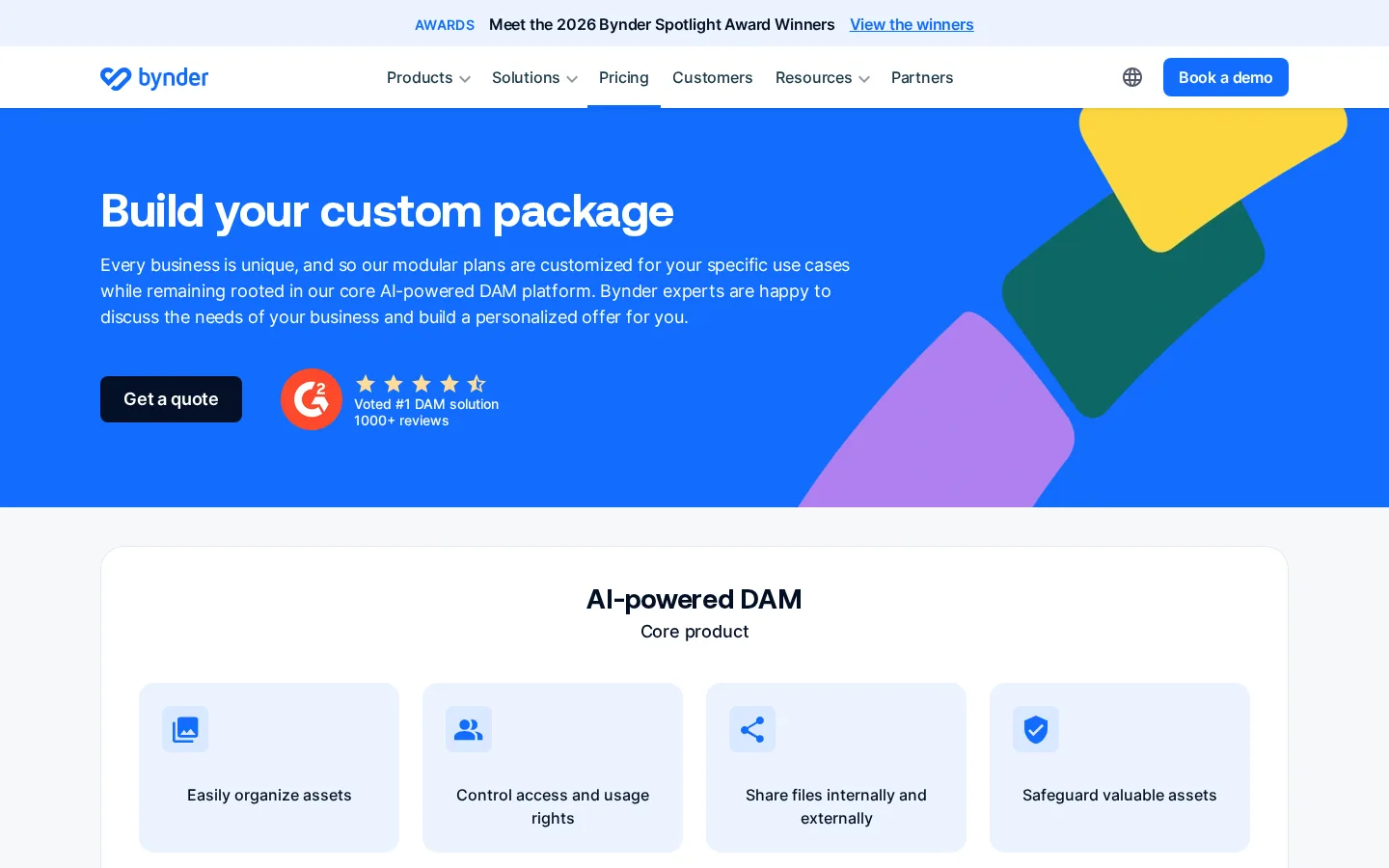
Bynder does not publish prices, but third-party contract data is consistent. Reported entry point is around $450/month for a small deployment (500GB). The median recorded contract across 76 purchases is about $41,417/year (Vendr, July 2026), with mid-market deals (25-50 users, core DAM plus one or two modules) landing at $30,000-$75,000/year, SMB deals averaging about $29,749/year, and enterprise contracts (100+ users, multiple modules) routinely passing $150,000/year. Two costs the quote will not mention: professional services run $10,000-$50,000+ on top, and renewal escalations average 20-23% a year across segments, which is the single most under-reported Bynder cost. The one vendor-published figure is a $66,000/year AWS Marketplace package. Pricing is modular, so Digital Brand Templates, Content Workflow, and Creative Automation are separate line items, not part of a base quote. We keep the full breakdown, with sources, in Bynder pricing: real costs and contract data.
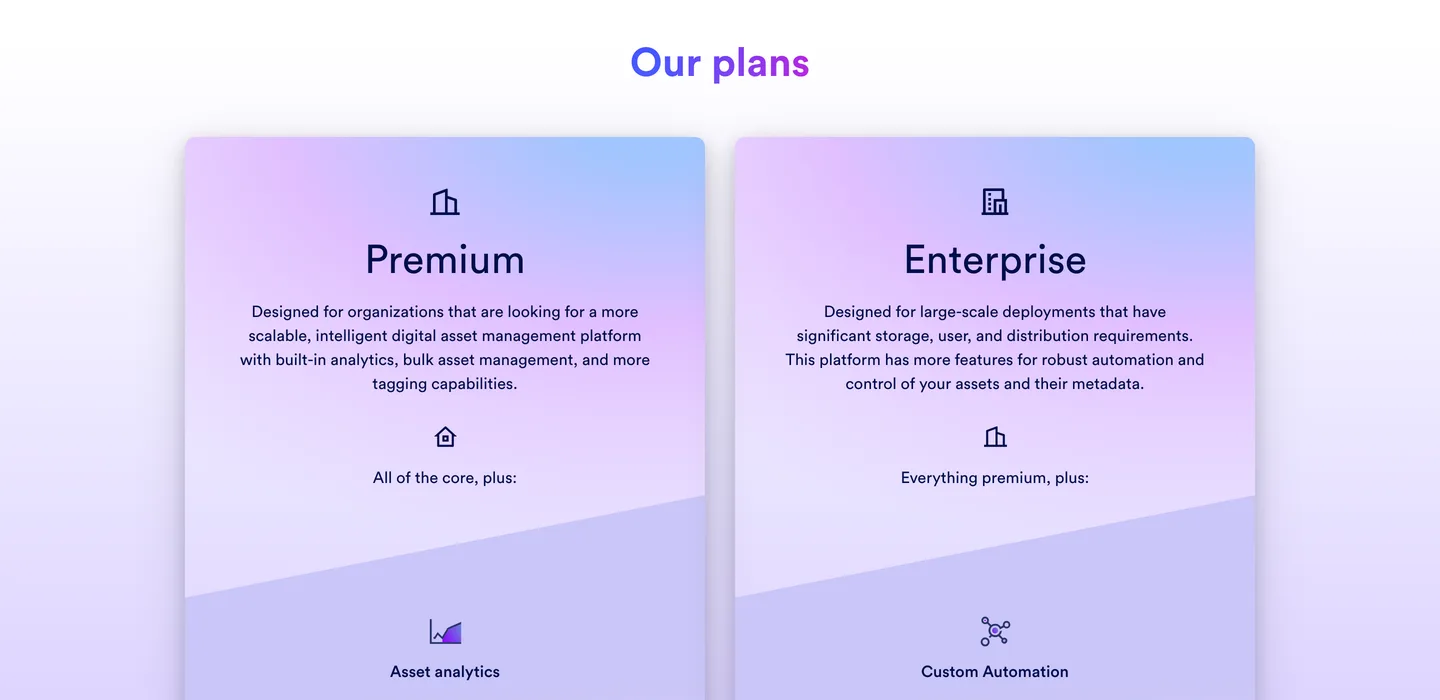
Brandfolder is also quote-only. As of a September 2026 check of its pricing page, it lists two plans, Premium and Enterprise, with no dollar figures anywhere on the page. The earlier three-tier structure (Basic/Premium/Enterprise) appears to have collapsed; third-party trackers still quote a Basic tier at roughly $500/month, which should be treated as legacy or unlisted rather than a currently advertised plan. Reported figures converge on $1,500-$3,000/month ($18,000-$36,000/year) for Premium depending on seats and storage, and $30,000-$150,000+/year for Enterprise. Onboarding and implementation add $2,000-$10,000+. What you get that Bynder does not offer: unlimited basic users and guest contributors at no additional cost, which materially changes the math for teams with many external stakeholders. The details live in Brandfolder pricing explained.
The practical pricing difference is not the median, it is the shape. Bynder's modular pricing means the quote you sign is a floor, with modules and 20-23% renewal escalations above it. Brandfolder's unlimited-guest model means external collaboration stops costing money, which matters if your asset library is mostly consumed by partners, retailers, or freelancers rather than internal teams.
Feature Comparison
| Capability | Bynder | Brandfolder |
|---|---|---|
| AI search | Extensive: natural language, search by image, text-in-image (OCR), speech-to-text, similarity, face recognition | AI visual search and auto-tagging; OCR document intelligence on Premium |
| AI beyond search | AI Agents platform for enrichment, governance, and personalization | Brand Intelligence: asset performance analytics |
| Creative workflow | Asset Workflow and Content Workflow modules | Creative Workflow included |
| Content creation | Studio (templating and creative automation, separate module) | Not a focus |
| Integrations | 145+ developed, plus a developer toolkit | Count not disclosed; Smartsheet native integration is the anchor |
| Guest and external users | Part of permissioning structure | Unlimited basic and guest users, no extra cost |
| Analytics | Workflow and content analytics module | Brand Intelligence is a flagship feature |
| Brand portals | Yes, plus CX Omnichannel delivery | Yes, a noted strength |
| Deployment | MACH Alliance, composable architecture | Smartsheet-owned, single platform |
The pattern is consistent: Bynder goes wider and deeper, Brandfolder concentrates on a smaller set of things and does them without training. Bynder's AI feature set is the most extensive in the category, and its composable architecture is real differentiation for IT buyers. Brandfolder's answer is that most users never touch most of that, and that usability decides whether a DAM gets adopted at all, which is a fair point: a DAM nobody logs into is the most expensive DAM of all.
Pros and Cons
Bynder pros: market leadership and credibility, the deepest feature set in the category, 145+ integrations, exceptional onboarding and support, proven enterprise scale.
Bynder cons: no transparent pricing, complexity that overwhelms smaller teams, a three-month structured onboarding (well-supported, but a real time investment), modular pricing that makes the first quote a floor, and 20-23% average renewal escalations.
Brandfolder pros: usability that testimonials consistently confirm, Brand Intelligence analytics, unlimited guest users, strong brand portal capabilities, Smartsheet integration if you already live there.
Brandfolder cons: no transparent pricing, undisclosed integration count, "most usable" can imply lighter feature depth, and the Smartsheet question: acquired in 2020, its long-term roadmap and standalone identity are tied to a parent company whose strategy is work management, not DAM.
Best Fit by Team Type
- Global enterprise brand, 100+ users, complex governance: Bynder. The modular architecture, access and usage-rights controls, and integration ecosystem are built for exactly this, and the budget conversation is normal at this size. Budget for the escalations at signing, and negotiate a cap.
- Mid-market marketing team that already runs on Smartsheet: Brandfolder. The native integration plus usability focus fits, and unlimited guest users suit teams whose assets are mostly consumed externally.
- Team whose real problem is proving asset ROI: Brandfolder. Brand Intelligence, which shows which assets get downloaded and engaged with, is the most developed answer in this pairing.
- Team that needs content creation and templating from the DAM: Bynder. Studio and Creative Automation exist; Brandfolder does not really compete here.
- Agency of 5-25 people managing multiple clients: neither, at least not first. See the next section.
The Third Option for Smaller Teams
Both platforms are built for mid-market and enterprise budgets and implementation timelines. If you are an agency or small brand team of 5-25 people, the numbers are blunt: Bynder's median recorded contract is about $41,417/year and Brandfolder's Premium tier starts at $18,000/year, for platforms whose enterprise capabilities a team that size will partly pay for and never use. The usual outcome is a team that needs organized assets, client approval flows, and a brand guide that stays current, buying an enterprise system and using 10% of it.
This is the segment we built Baseline for, so take the recommendation with that context. Baseline is a DAM with a publishing layer attached: assets publish directly as live brand guides, galleries, and client portals, and updating an asset in the library refreshes it everywhere it is published, which removes the duplication between storage and presentation that both Bynder and Brandfolder leave you to solve separately. Client workspaces are isolated from each other, freelancers can be invited to a single board without seeing other clients' work, and clients can comment on share links without creating an account. Pricing is published: plans run from $59/month to $399/month, with a genuinely free plan rather than a trial countdown.
For a like-for-like read of one vendor against Baseline, see Baseline vs Bynder and Baseline vs Brandfolder. If you are earlier in the funnel and want the whole field, every DAM head-to-head covers the other matchups, and what DAM platforms actually cost puts the pricing in one table.
Frequently Asked Questions
Which is better, Bynder or Brandfolder?
Bynder is the stronger platform overall: deeper features, more integrations, more extensive AI, composable architecture. Brandfolder is the easier one to adopt and includes unlimited guest users. If your purchase committee weights capability and governance, Bynder wins. If it weights time-to-adoption and external distribution, Brandfolder wins. Neither wins on price transparency, because neither publishes a price.
Is Bynder more expensive than Brandfolder?
Bynder's reported entry point (~$450/month) is lower than Brandfolder's advertised Premium tier ($1,500-$3,000/month), but Bynder's ceiling is higher. Reported Bynder contracts run from that entry to $150,000+/year at enterprise, with a median around $41,417/year and renewal escalations averaging 20-23% annually. Reported Brandfolder Premium figures run $1,500-$3,000/month with Enterprise at $30,000-$150,000+/year. Both are quote-only, so treat every number, including these, as contract data rather than list prices.
What happened to Brandfolder after Smartsheet bought it?
Brandfolder was acquired by Smartsheet in 2020 and operates as part of a publicly traded company. The product continues, and the Smartsheet integration is a genuine advantage if you already use Smartsheet. The open question is roadmap priority: DAM is not Smartsheet's core business, so evaluate Brandfolder on what it does today rather than on promised developments.
Which is easier to set up?
Brandfolder, by a clear margin. Usability is its entire market position and its customer testimonials consistently confirm it. Bynder runs a structured onboarding that its customers praise, but it takes about three months, which tells you what kind of implementation you are signing up for.
What if my team is too small for either?
That is a real scenario, not a failure mode. If you are an agency or brand team under roughly 25 people, a lighter DAM with published pricing, client workspaces, and a built-in brand guide publisher will likely cover you for a fraction of the cost. Baseline, which we make, is built exactly for that segment, and you can start on a free plan without a sales call. See how it compares to Bynder here.
Compare the two platforms against your team's actual size rather than its aspirational one, then pick on that basis. If that is a lighter, published-price DAM with publishing built in, start a Baseline workspace free.