
Brand asset management software is how a team keeps its logos, fonts, colors, photography, templates and guidelines in one governed place, so that the file someone downloads is the current one and the brand looks the same everywhere it shows up. If you are evaluating platforms, you have probably noticed that most comparisons dodge the question everyone actually asks first: what does it cost?
This guide compares six platforms: Baseline, which is our product, alongside Air, Brandfolder, Bynder, Canto and Frontify. Every price here carries the date it was verified, and where a vendor publishes no prices at all, we say so, because that silence is itself a data point. Where it matters we also say who each platform is a bad fit for, including our own.
Last updated: November 9, 2026. Prices were read from each vendor's live pricing page in a real browser on the dates shown, with the monthly/annual billing toggle checked; "quote only" means no dollar figure appeared anywhere on the page. If you want the concept and the workflow before the shopping list, start with our guide to what brand asset management actually involves.
Quick Comparison
| Platform | Published pricing | Entry cost | Best for | Weakest for |
|---|---|---|---|---|
| Baseline | Yes, all tiers | $0 forever (1 GB), paid from $588/year | Small to mid teams that also want live brand guides and portals | Enterprise governance like SSO outside the top tier |
| Air | Yes, all tiers | $0 (10 GB), paid from $1,200/year | Small creative teams that live in fast visual collaboration | Price and structure have churned repeatedly since 2020 |
| Brandfolder | No, quote only | Roughly $1,500-$3,000/month reported for Premium | Mid-market and enterprise marketing teams wanting analytics | Teams that need a price without a sales call |
| Bynder | No, quote only | Not published | Large organizations with complex brand governance | Small teams; the platform is built for enterprise scale |
| Canto | No, quote only | Not published | Mid-market brands wanting a straightforward DAM with AI search | Transparent budgeting; reported per-seat costs add up |
| Frontify | No, quote only | Not published | Global brand teams running guidelines and partner portals at scale | Anyone expecting self-serve pricing |
What Brand Asset Management Software Has to Do
Before the platforms, the checklist. Any tool that deserves the name should handle these, and if it cannot, the rest of its feature list does not matter:
- One source of truth. Every approved asset lives in one place, with versioning that makes the current file obvious and the retired file hard to reach by accident.
- Findability. Search that works on visual content: tags, visual similarity, metadata. If finding a logo still means asking a designer, nothing was managed.
- Guidelines next to assets. The logo and the rule for how it is used belong in the same system. A PDF brand book in a separate drive is where consistency goes to die, which is the argument for living brand guidelines over static ones.
- Controlled sharing. External people such as clients, printers and franchisees get scoped access without a license per person and without seeing the whole library.
- Approval as a state. An asset is approved because someone recorded it, not because nobody complained in a meeting. Approval workflows and visual review matter more than storage numbers.
The Six Platforms
1. Baseline
Baseline is a digital asset management platform that adds a publishing layer: your assets do not just sit in storage, they can go live as brand guides, photography galleries and client portals. Update a logo in the library and the published pages that use it refresh, which removes the classic gap between "the file is fixed" and "the brand guide still shows the old one."
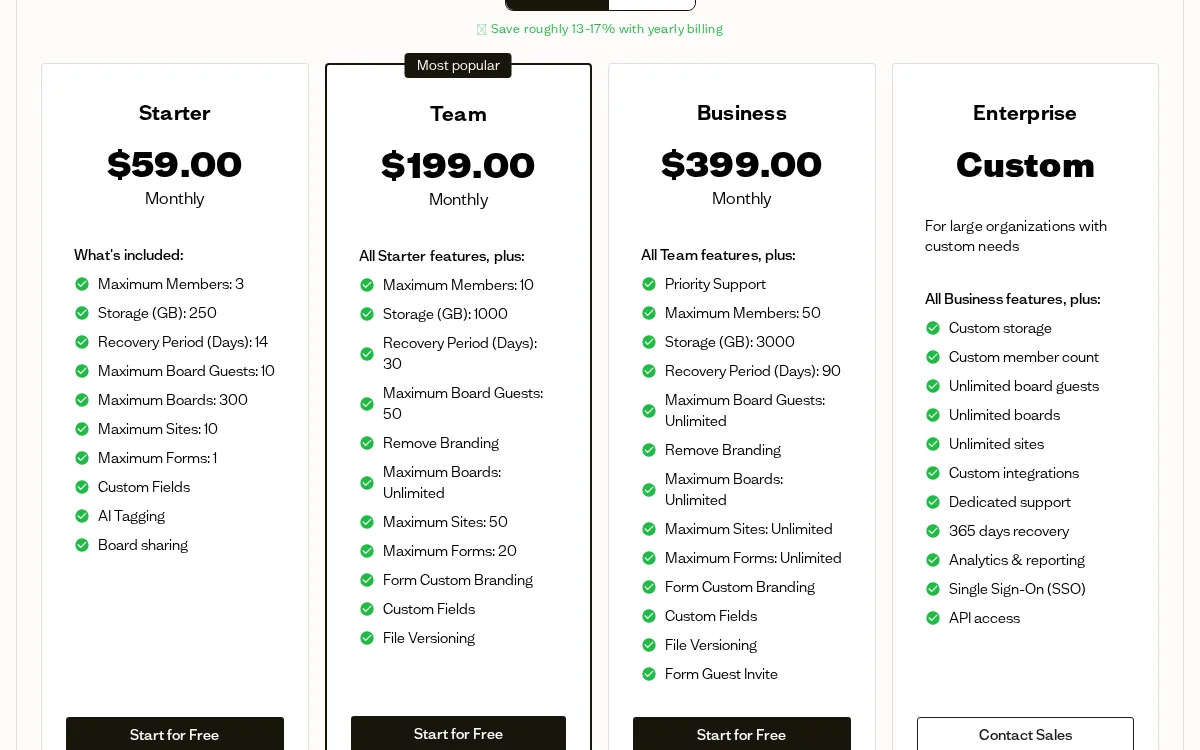
Pricing (published, current as of November 2026): a genuinely free plan with 1 GB of storage, 2 team members and live brand guide publishing, with no trial countdown and no credit card. Starter is $588/year (250 GB, 3 members), Team is $2,028/year (1 TB, 10 members), Business is $4,188/year (3 TB, 50 members), and Enterprise is custom, adding SSO and API access. Every tier price is public with no sales call required below Enterprise.
Best for: agencies and brand teams of roughly 2 to 50 people who want storage and presentation in one system, especially anyone producing client-facing brand guides or galleries.
Where it falls short: if you need enterprise-grade governance such as SSO across hundreds of seats, you are looking at the Enterprise tier and a conversation, and deep multi-brand hierarchies for a global holding company are not its center of gravity.
2. Air
Air is the lightweight, collaboration-first option, originally positioned as the affordable DAM for small creative teams. It is fast, visual and pleasant for teams whose work moves through lots of quick rounds.
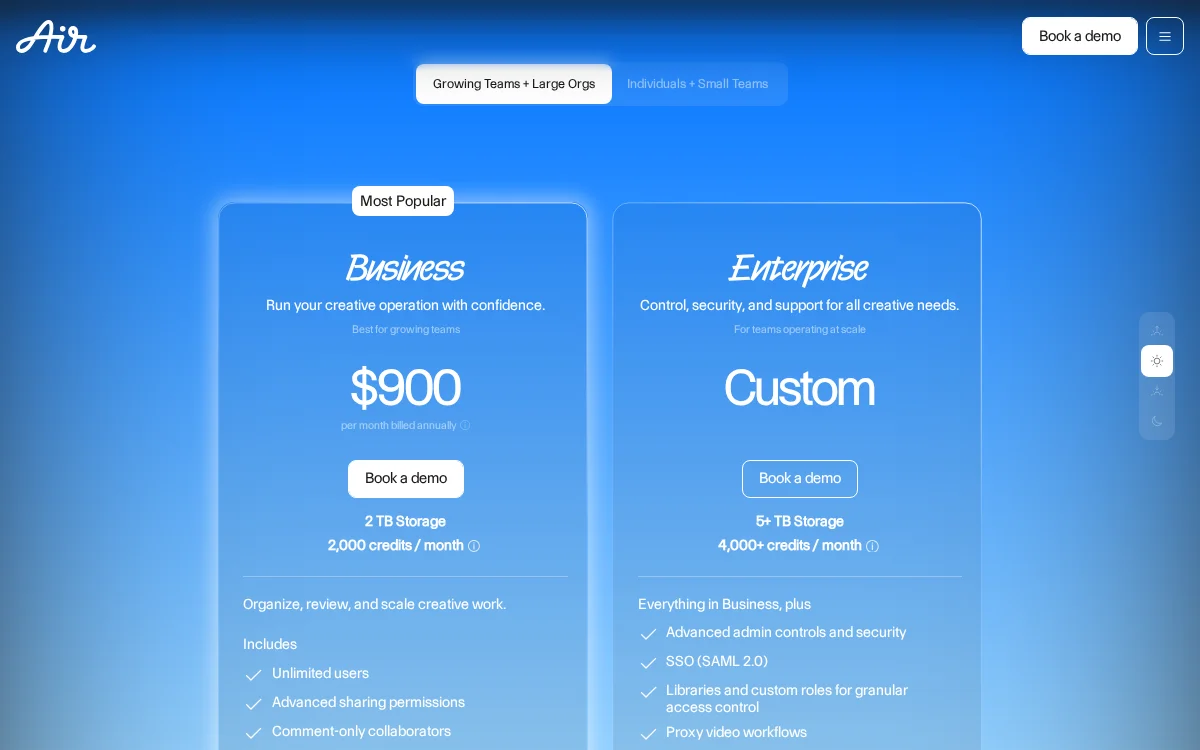
Pricing (published, verified live November 6, 2026): Free at $0 with 10 GB and 3 users, Starter at $1,200/year with 200 GB and a 5-user cap, Business at $10,800/year with 2 TB and unlimited users, Enterprise custom. It bundles more than 50 AI models into the platform.
Best for: small in-house creative teams that want speed and AI tooling without a procurement process.
Where it falls short: the fine print is the history. Air has restructured its pricing four times since 2024, most recently in late 2026 when Starter jumped to $125/month month-to-month and gained a hard 5-user cap. Business at $10,800/year is roughly 2.6 times Baseline's Business tier while including less storage. Budget for change, not just for the number on today's page.
3. Brandfolder
Brandfolder, owned by Smartsheet, sells itself as the most usable DAM, with asset analytics and intelligence features layered on top of storage. It reports more than 5,000 brand customers.
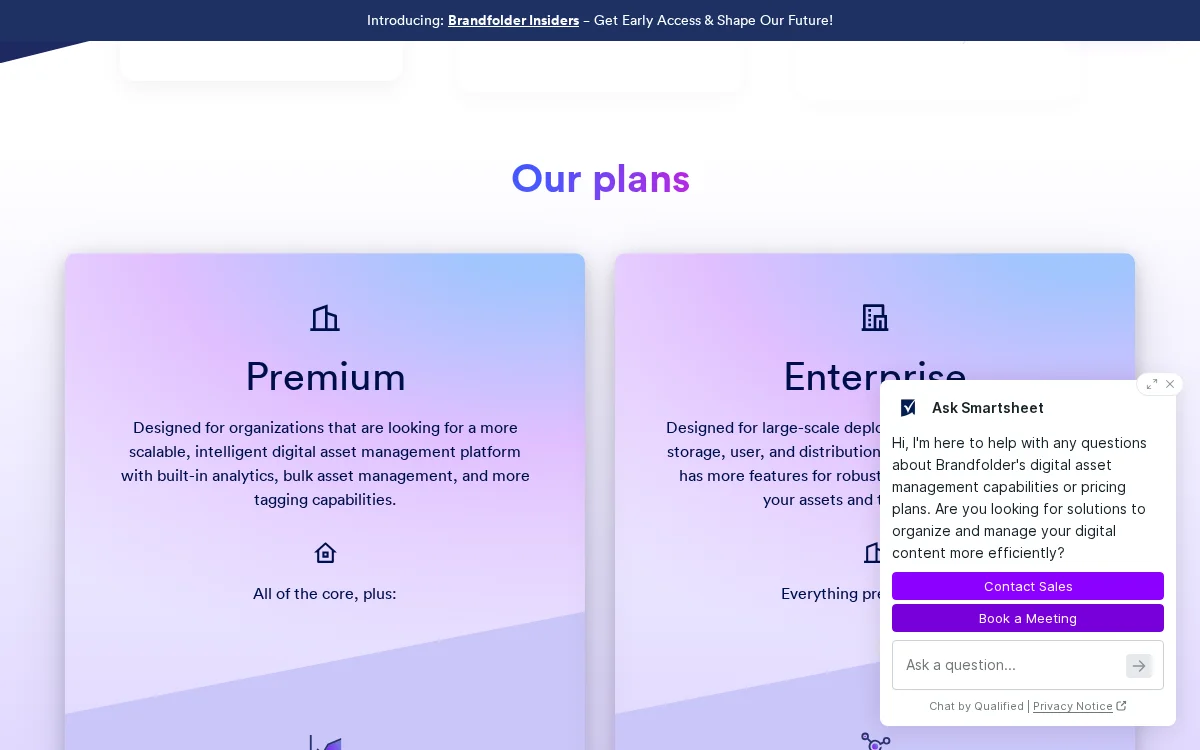
Pricing (not published; quote only): the live pricing page as of the September 26, 2026 primary-source check lists Premium and Enterprise tiers with no dollar figures anywhere and a "get a quote" flow. Third-party price trackers converging in September 2026 put Premium at roughly $1,500 to $3,000 per month depending on seats and storage, Enterprise at $30,000 to $150,000+ per year, and onboarding at $2,000 to $10,000+ on top of the subscription.
Best for: mid-market and enterprise marketing teams that want asset performance analytics and have the budget and procurement process for a quoted platform.
Where it falls short: there is no self-serve tier and no public price, so small teams cannot even window-shop, and the reported entry point is far above the published-price platforms in this list.
4. Bynder
Bynder is the enterprise incumbent of this list: more than 4,000 customers including about 20 percent of the Fortune 500, 1.7 million users, and 145+ integrations. It is a serious brand governance machine.
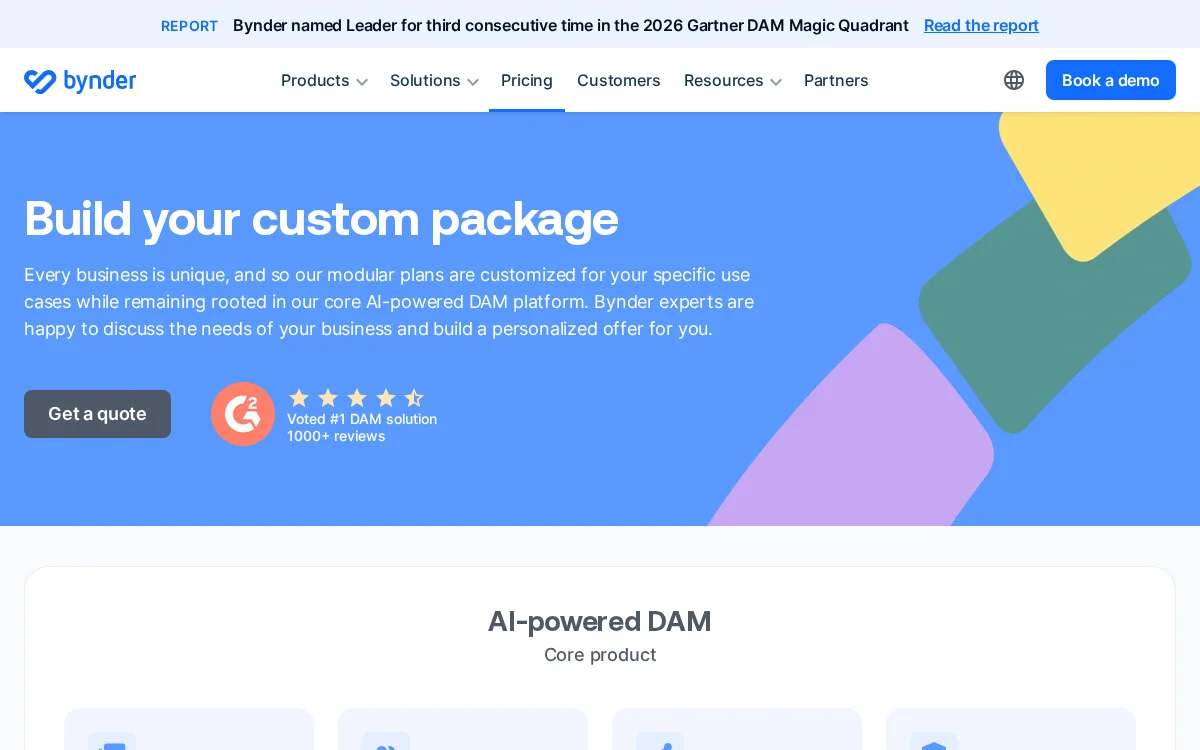
Pricing (not published; verified live November 9, 2026): the pricing page shows no dollar figures at all and runs on a "build your custom package" model where you assemble modules around the core DAM. Every path leads to a demo and a quote.
Best for: large organizations with multi-market brand governance, complex approval structures, and integration needs. If your problem is scale and consistency across dozens of markets, Bynder is built for exactly that.
Where it falls short: for a small agency or a ten-person brand team, it is widely characterized as overkill in both complexity and cost. You cannot buy it without a sales process, and the packaging is too modular for a simple price comparison.
5. Canto
Canto is the mid-market workhorse: a straightforward DAM that has recently been pushing AI search under the Canto XI banner, unifying brand and product content in one hub.
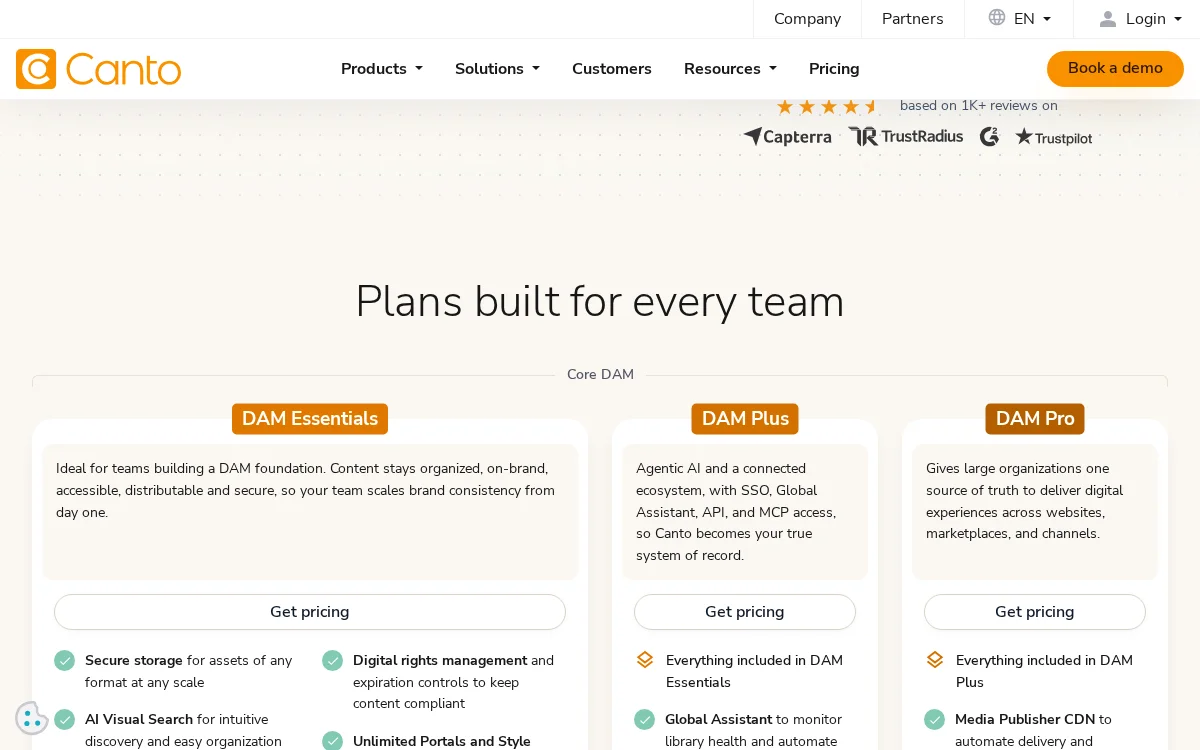
Pricing (not published; verified live November 9, 2026): the pricing page advertises two packaged plans, Core DAM and Built on DAM Pro, with quote-based pricing and no dollar figures. Third-party trackers in September 2026 reported power-user pricing around $1,000 per user per year.
Best for: mid-market brands that want a conventional DAM with broad industry fit and AI-assisted search, and are comfortable with a quoted price.
Where it falls short: without published prices you cannot comparison-shop, and if the reported per-user figure holds for your seat count, costs climb quickly for larger teams.
6. Frontify
Frontify is less a DAM and more a complete brand management platform: DAM storage, interactive brand guidelines, templates and brand portals in one system, aimed at organizations with complex brand hierarchies and external partner networks.
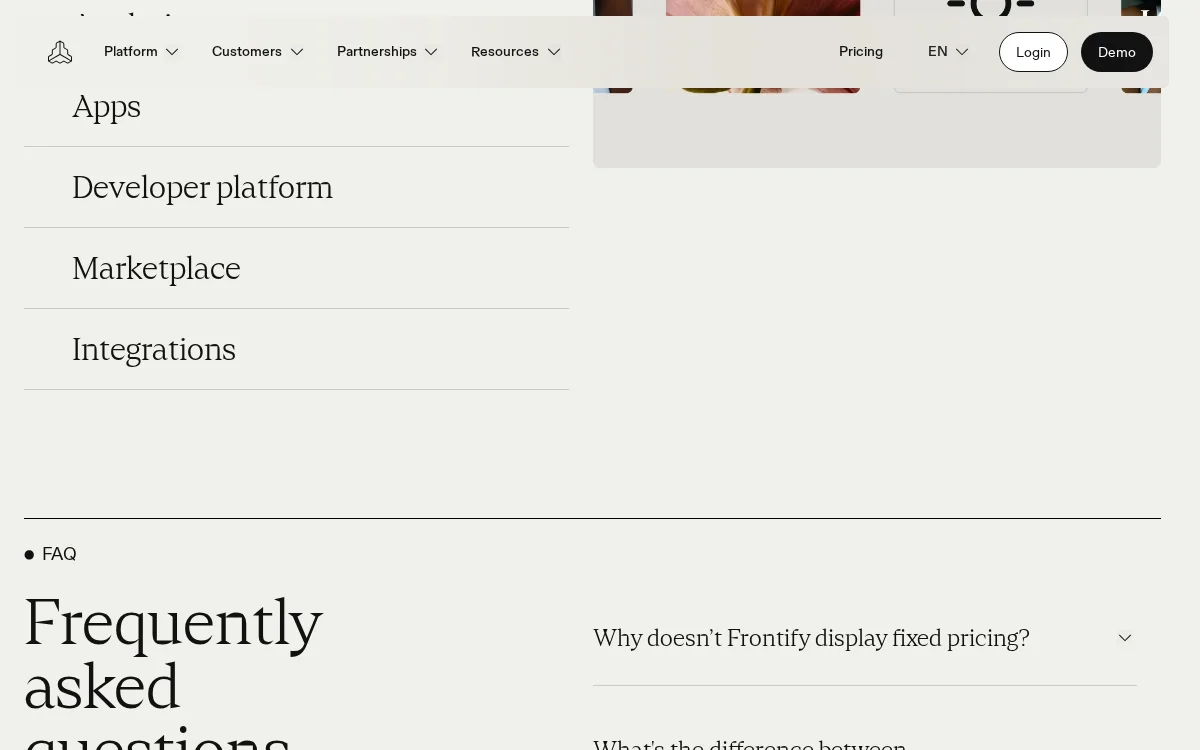
Pricing (not published; verified live November 9, 2026): Frontify's own pricing page FAQ literally asks "Why doesn't Frontify display fixed pricing?" and the answer is a quote process. No dollar figures appear anywhere on the page.
Best for: global brand teams whose real problem is keeping guidelines, portals and assets coherent across regions, subsidiaries and partners. For that job it is the most complete platform here.
Where it falls short: it publishes no prices and bills on monthly active users, which is the hardest model in this list to budget from, and teams wanting only storage with publishing will pay for brand governance machinery they may not use.
How to Choose
The honest decision path is shorter than most vendors make it:
- If you want a published price and a free start: Baseline and Air are the only two on this list you can buy today without a sales call. Compare them on what they do with assets after storage: Baseline publishes them as live guides and portals, Air leans into AI content tooling and fast collaboration. See our detailed Baseline vs Air comparison for the feature-level breakdown.
- If you are a mid-market or enterprise team: get quotes from Brandfolder, Canto and Frontify, and budget for onboarding fees, which are real money on top of subscription at the quoted end of the market.
- If brand governance across many markets is the actual problem: Bynder and Frontify are purpose-built for it, and their cost is the cost of that problem.
- If you are an agency buying for many clients: per-seat and per-client structure matters more than list price, and our DAM software guide for creative agencies goes deeper on that specific buying situation.
One warning that applies across the market: do not compare platforms on storage numbers alone. Two plans with "2 TB" are not the same product if one includes approval workflows, client sharing and publishing, and the other is raw storage with a logo. Our DAM pricing comparison breaks down what each dollar actually buys across the market.
Frequently Asked Questions
What is brand asset management software?
It is a platform that stores, organizes and governs everything that represents a brand: logos, fonts, colors, photography, templates and guidelines. It differs from generic file storage through version control, controlled sharing, approval states and brand rules living next to the assets. The full guide to brand asset management covers the practice in depth.
How much does brand asset management software cost?
Anywhere from free to six figures a year. Published-price platforms run from $0 to about $10,800 per year in this list, with Baseline's paid tiers at $588 to $4,188 per year. Quote-only vendors such as Brandfolder, Bynder, Canto and Frontify commonly land in five figures annually for mid-market deployments once seats, storage and onboarding are counted.
Is brand asset management the same as digital asset management?
They overlap heavily, and the terms are often used interchangeably. DAM is the broader category of storing and governing any digital assets, while brand asset management tools tilt toward brand-specific concerns: guidelines, consistency and how the brand is presented to the outside world. Most platforms in this comparison sell one product that does both.
Do I need the enterprise tier?
Usually not at first. Enterprise tiers exist for governance at scale: SSO, custom integrations, complex permissions and contractual terms. If you cannot name the feature you need from the enterprise tier, the tier below it is almost always enough, and affordable DAM options cover the low end of the market in detail.
The Bottom Line
Most roundups of this market rank tools their authors have never paid for and skip the pricing question entirely. The practical takeaway from actually checking: only two of the major platforms will tell you what they cost, and Air has changed its pricing model three times in roughly two years while Baseline publishes a single rate card it has held since September 2026. Get the published numbers, get written quotes from the quote-only vendors before you shortlist them, count onboarding and per-seat costs, and pick the platform whose storage connects to the thing your team actually does with the brand afterwards.
Next Step
If Baseline looks like the right shape for your team, the fastest way to know is to create a free account, which takes a minute and needs no credit card. Upload a handful of your logos and photography, publish a brand guide from them, and see how long a teammate takes to find the one current file. When you want the full picture, the pricing page lists every tier, what it includes, and what it costs, with no quote required below Enterprise.